The Keepers of the Mainframe: Who’s up Next?
With the job description of “mainframer” shifting, organizations are urged to prepare for the next generation of technologists
By Craig Mullins
The Keepers of the Mainframe: Who’s up Next?
With the job description of “mainframer” shifting, organizations are urged to prepare for the next generation of technologists
By Craig Mullins
As organizations continue to rely on IBM Z for mission-critical workloads, a looming challenge threatens to impact long-term stability and performance: the mainframe skills gap. With many seasoned professionals nearing retirement and fewer new entrants pursuing careers in mainframe computing, the question becomes urgent: Who will run your IBM Z in 2030?
The Talent Time Bomb
For decades, IBM Z has served as the backbone of enterprise IT, supporting high-volume transaction processing, secure data handling and unparalleled system availability. However, the demographic reality is stark. A significant portion of the current mainframe workforce is aging out, with surveys indicating that many mainframe professionals plan to retire within the next five to 10 years.
At the same time, misconceptions persist that the mainframe is outdated, difficult to work with or incompatible with modern development practices. These myths discourage young IT professionals from exploring mainframe careers, worsening the talent shortage.


45% of said a lack of cybersecurity skills hinders their ability to modernize their mainframe environments

41% voiced a need for mainframe-specific skills like z/OS Connect and Zowe

One-third said their organizations were lacking in skill in programming languages like COBOL, RPG and CICS.
Source: Kyndryl
SPONSORED CONTENT
Transform COBOL to Java

Java allows for writing reusable object-oriented code, which means developers can build upon existing codebases instead of starting from scratch each time.

Java can be open sourced, IDE's and compilers are low cost or free, and specialty processors can lower processing fees on mainframes.
A Java-based system is easier to integrate with modern platforms, critical for businesses looking to adopt a microservices or expand their suite of applications.

Moving to cloud servers can be less expensive to operate than on-premesis midrange or mainframe hardware, with the right amount of preparation and planning.

Building the Pipeline
The good news is that the mainframe community has not stood still. IBM, along with its partners and clients, has taken proactive steps to address the pipeline issue. Programs like the IBM Z Academic Initiative and Master the Mainframe (now IBM Z Xplore) introduce students to mainframe concepts and provide hands-on experience through challenge-based learning and real-world problem solving.
Universities around the world are also integrating IBM Z coursework into their curricula, helping to expose students to the mainframe before they enter the job market. Meanwhile, industry-driven apprenticeship programs, internships and co-op placements are playing a vital role in giving early-career professionals a meaningful on-ramp to mainframe roles. For example, Broadcom, a large mainframe software vendor, contributes with its Mainframe Vitality Program by recruiting and training students interested in pursuing a mainframe career.
Shifting the Experience
One of the most effective ways to attract younger talent is to modernize the development experience. Tools like Zowe, an open-source project supported by the Open Mainframe Project, offer a familiar environment with command-line interfaces, REST APIs and web-based tools that align with what modern developers expect.
In parallel, support for Git-based version control, CI/CD pipelines, and integration with DevOps toolchains is becoming increasingly common on the mainframe. This convergence of traditional reliability with modern agility is breaking down barriers to entry and making mainframe work more accessible and engaging. IBM contributes to this ongoing transformation to DevOps on the mainframe with its DevOps for IBM Z initiative.

Knowledge Transfer: A Race Against Time
Even with new talent entering the pipeline, a significant challenge remains: How do we preserve the decades of institutional knowledge that retiring mainframers carry with them? Structured knowledge transfer programs are essential.
Organizations need to document processes, capture best practices and encourage mentoring relationships between senior and junior staff. Shadowing sessions, internal wikis, video walkthroughs and collaborative coding exercises all help to bridge the knowledge gap.
Cultural factors also matter. Organizations must create an environment where experienced professionals are incentivized to teach and mentor. This is not just about succession planning—it’s about ensuring the ongoing resilience of mission-critical systems and applications.
The Hybrid Skillset
Rethinking Mainframe Roles
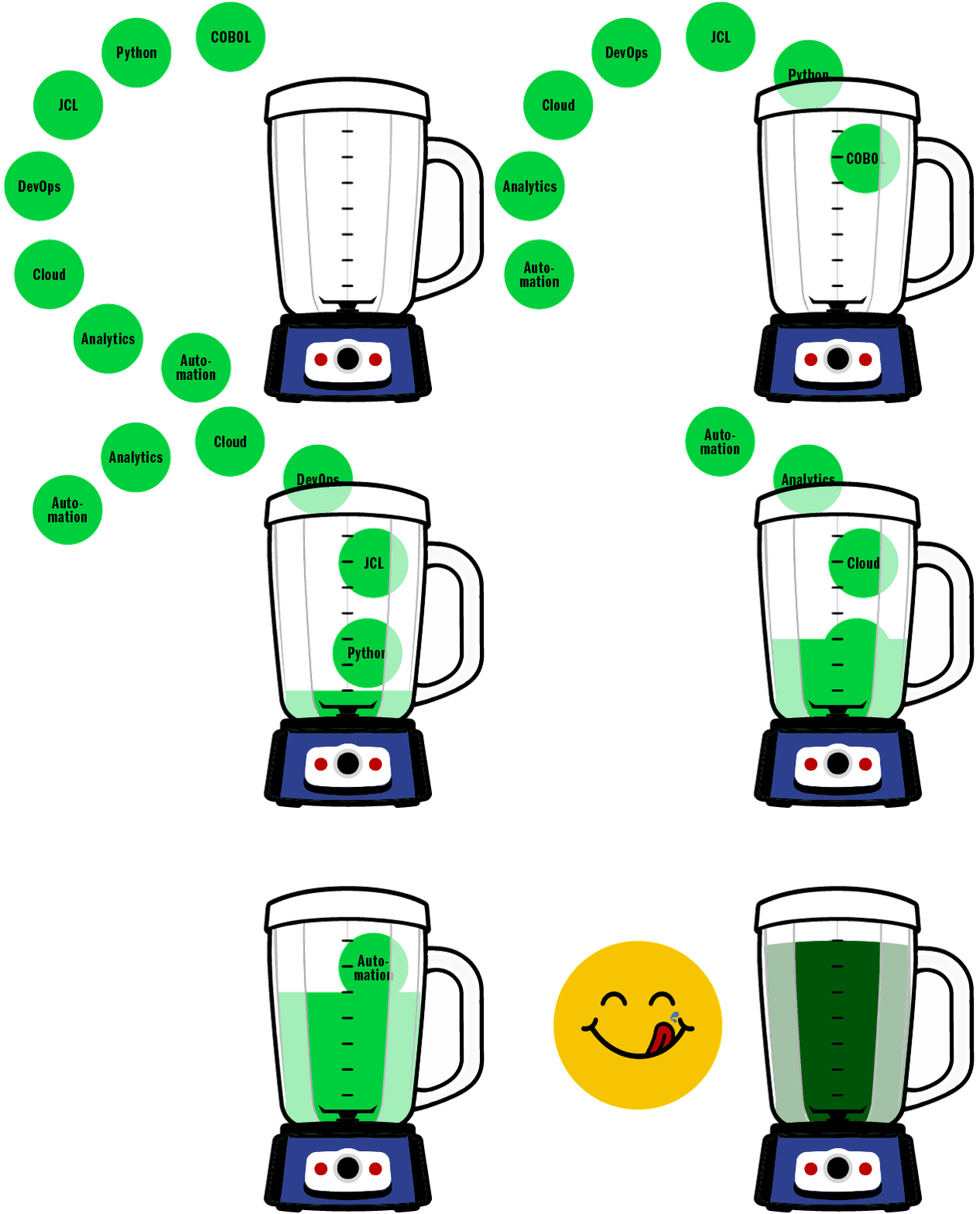
As tools and platforms evolve, so too do the roles supporting the IBM Z platform. The traditional "mainframe operator" is giving way to hybrid roles such as "DevOps engineer for Z," "mainframe site reliability engineer (SRE)" and "z/OS data engineer."
These roles demand both foundational mainframe knowledge and fluency with cloud-native concepts, automation and analytics. Training programs need to reflect this hybrid skillset, blending COBOL and JCL fundamentals with Python, Ansible and container orchestration.
Investing in the Future
Ultimately, the future of IBM Z depends not just on technology but on people. Organizations that invest in workforce development today will be the ones that continue to reap the rewards of the mainframe's legendary performance, security and reliability in the decades ahead.
This means engaging with academic institutions, supporting certification programs and funding internships and mentorships. It also means embracing cultural change wherein mainframe skills are treated as modern and vital, not legacy and obsolete.
Top Mainframe Skills to Develop
If you are an IT professional looking to work on the mainframe, there are many specific skills required. Although some skills, such as problem analysis, debugging and performance optimization are common on all platforms, different mainframe-only skills are important. The top 5 areas where you can look to develop your mainframe skillset include:
1. Programming Languages

2. Database Management

Data is a crucial skill on every platform, and the mainframe is no different. Being able to access, manage, and manipulate data is an important skill for any IT professional working on the mainframe. Learning the particulars of Db2 for z/OS is crucial for any IT professional looking to improve their mainframe skillset.
Although Db2 for z/OS is the database management system (DBMS) of choice for most mainframe applications, Information Management System (IMS) still maintains a significant presence. IMS/DB is a pre-relational hierarchical DBMS requiring different skills to code for and manage than a relational DBMS like Db2.
Even though Db2 and IMS programming and development skills are needed, so are database administration and system programming skills for both.
3. Batch Development and Management

4. Transaction Processing
5. Other Mainframe-Specific Technologies

There are additional mainframe-specific skills that are required to achieve effectiveness as a mainframe professional. For example, developers skilled in Time Sharing Option (TSO) and Interactive System Productivity Facility (ISPF) will be more effective interacting with the mainframe infrastructure. TSO is the base interactive command-line environment on z/OS. It allows users to log on to the mainframe and interact directly with the system by entering commands. ISPF is a full-screen, menu-driven application that runs on top of TSO. It provides a more user-friendly and structured way to interact with z/OS.
Other key technologies for improving your ability to operate within the IBM Z system environment include:
- System Display and Search Facility (SDSF) for monitoring jobs and started tasks.
- Data Facility Storage Management Subsystem (DFSMS), a suite of products for managing storage on z/OS.
- Resource Access Control Facility (RACF), a security product for controlling access to resources on z/OS. Although RACF is the most popular example, other mainframe security offerings include ACF2 and Top Secret, which deliver similar functionality.
- System Management Facility (SMF) for collecting log records and job-related information for accounting and performance analysis.
The bottom line is that the mainframe requires similar development and management skills as other environments, but uses different tactics, techniques and software. There will be a learning curve when you move from any other environment to the mainframe.
The Time to Act Is Now
The path to 2030 may seem distant, but the preparations must begin now. By nurturing new talent, modernizing the mainframe experience and valuing knowledge transfer, organizations can ensure their IBM Z systems remain well managed and future-proof.
