Building Supportive Environments for New Tech Workers
In today’s competitive IT labor market, it can be hard for organizations to find people with the skills they need, making training and nurturing talent critical areas of focus. Thomas Vick, senior regional director at Robert Half, explains what organizations are doing to support workers who are new to their tech surroundings.
Onboarding new hires isn’t typically a plug-and-play proposition for any organization. This reality is especially true in IT, where new hires often find themselves in unfamiliar tech ecosystems requiring highly specialized skills that have to be learned on the job.
This set of circumstances makes it all the more important for IT departments to support and nurture their fresh talent. When that mission is successful, the IT community benefits from the kind of technologists featured in TechChannel’s Rising Stars program, which honors those who have already made an impact early in their IBM Z and Power careers.
To learn more about organizations’ efforts to produce similar success stories, TechChannel spoke with Thomas Vick, who specializes in placing IT professionals as senior regional director at Robert Half, the global human resources consulting firm.

A Scarcity of Skill
"It's still a very tight IT employment market,” Vick said. “You've still got a lot of positions within IT that are sub 2% unemployment, which is extremely low."
In the U.S., unemployment rates for IT positions range from .6%, for database administrators and architects, to 2.9%, for software developers. Meanwhile, the general unemployment rate in the country hovers just over 4%.
Unemployment rates for IT positions
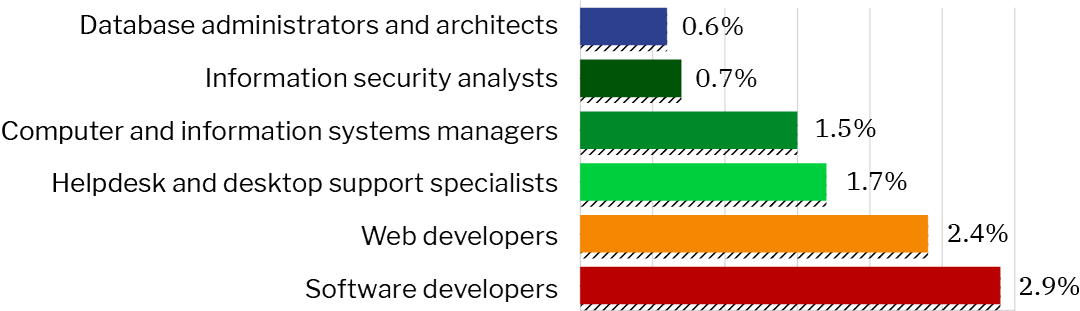
Source: U.S. Bureau of Labor Statistics, Oct. 4, 2024
Since unemployment rates signal the demand for labor, organizations know their new hires may not arrive with all the skills they need to work in a given tech ecosystem. “Most hiring managers within the IT realm are saying that they cannot find the level of talent that they're looking for,” Vick said.
Supportive Environments Crucial Amid Industry Changes
Hiring challenges can be heightened when organizations rely on legacy systems that use programming languages like COBOL and RPG that are not as commonly taught as their newer counterparts.
Meanwhile, organizations are changing how they view the role of IT, creating more demand for specialists in the field. “More and more organizations are looking at it now as a possible revenue-generating aspect of the business. Before, it was really seen as more of a cost center part of the business,” Vick said.
Given all these factors, supporting workers as they get up to speed becomes more crucial. “A lot of employers are looking at, ‘How do we upskill the talent that we have? How do we retain the talent that we have,’” Vick said. This means that being able to hire someone who may not have the requisite experience “is more imperative right now than ever before.”
Stepping into a new tech environment can be a daunting experience, Michael Gildein, z/OS product supply chain security architect at IBM, observed at the IBM Z Day virtual conference in October. "There are many, many things to learn when you start in this field. You can very easily feel lost," he said.
While workers focus on closing the skills gap, they might also contend with a generation gap. “The mainframe specialists, the majority of them are almost with 30 years of experience,” Torrie McLaughlin, principal mainframe engineer at the airline data company ATPCO, said at IBM Z Day.


There are many, many things to learn when you start in this field. You can very easily feel lost.
Focusing on Mentorship
The lopsided distribution of experience levels makes for a deep pool of potential mentors, and companies are putting those resources to use. “More and more are adopting mentorship programs internally,” Vick said.
When Gildein started in IT, he found it helpful to meet with his mentor 30 minutes each day during his first few months on the job. “I would have a list of acronyms and things I didn't understand and say, ‘Could you fill in the gaps for me and understand what this is, or [show me] where I’d find more information about it?’ Because trying to connect those dots was quite tedious,” he said.
Now, Gildean is a mentor himself. “I've repeated that with new hires and they found it very helpful as well, where you have a dedicated time to kind of debrief and discuss what you learned during the day,” he said.
Encouraging Collaboration
Mentors don’t have to be vastly more experienced than those they are advising. Tech managers have found peer-to-peer mentoring beneficial as well. Aside from the knowledge sharing, this form of mentorship can also help with team building.
“This is actually a topic that's very close to my heart,” McLaughlin said, “mostly because in every new job that I have been given, every new role that I have been given, there's usually a peer that I am able to train with where we're learning together, we're growing together. And by design, having that person to bounce ideas off of—it creates a friend in your team.”
Such relationships can also be built in other collaborative endeavors. They can take the form of hackathons that allow employees to engage in creative problem solving together, Vick said, or in sandbox environments where employees can play and tinker with their company’s technology without worrying about affecting operations.
Having that person to bounce ideas off of—it creates a friend in your team.
Job rotation programs promote intermingling, too. These programs help staff broaden their skill sets while allowing them to explore different career paths within their organization as they learn how their work fits into the larger picture, notes the Robert Half report, "Building Future-Forward Tech Teams.”
Considering Soft Skills and Personality Types
As organizations encourage employees to work with colleagues outside of their immediate team, soft skills play a crucial role in providing support.
“You've got more and more organizations looking at DevOps environments where the IT team is directly interacting with the operations,” Vick said. “And so having those soft skills, that ability to communicate, that ability to articulate with these individuals, is extremely important and really becoming more and more important by the day.”
For managers, one important soft skill is assessing personality types and knowing when to proactively offer guidance. “Especially in technology, there is a high number of people that are not very outspoken,” McLaughlin said.
These workers are technically savvy and “brilliant at what they do,” she continued, “but they don't always look up and go to their mentor for questions or ask their manager for coaching.”
Retaining Talent
After devoting considerable resources to training new employees, cooperative environments can help organizations keep their newly skilled employees in the fold. “I know that's a big issue for a lot of companies,” McLaughlin said. “...Helping to create those relationships and have that lasting community in your organization is going to help with retention.”
Aside from the eternally relevant factor of employee compensation, another common retention factor is working arrangements, especially in a post-COVID world where remote work is common. “What we've found through a lot of our research with Robert Half is that flexibility is still very key,” Vick said. Whether it’s a work-from-home or a hybrid model, employees “really still want that flexibility as to how they work, as much as it can be given.”
The goal, after all, is to not only train your talent, but to keep it.